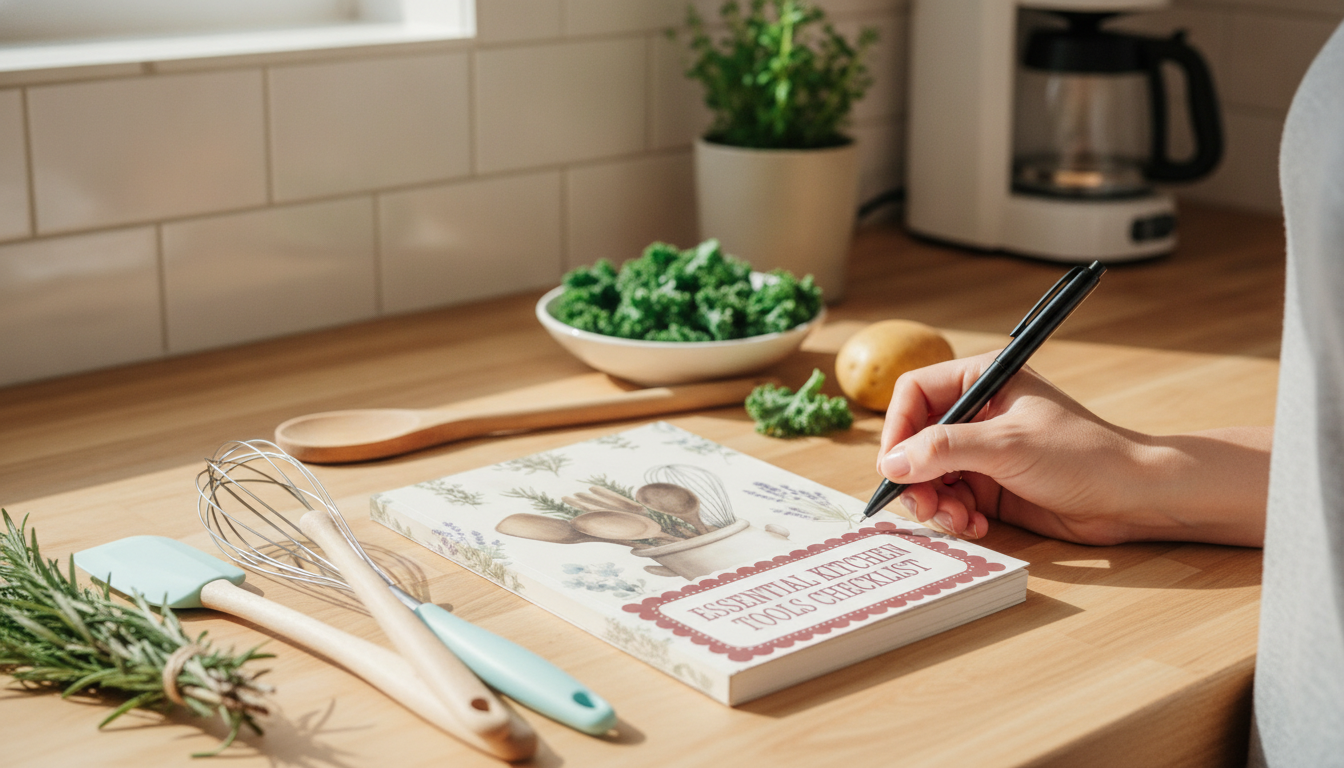
A well-set kitchen doesn’t require dozens of gadgets—it needs a reliable core of tools that make everyday cooking easier, safer, and more consistent. This printable checklist is designed for beginners, new homeowners, students, and anyone resetting a kitchen, helping prioritize what to buy first, what to upgrade later, and what to skip until it’s truly needed.
Instead of grabbing random gadgets because they look useful, the checklist nudges your kitchen toward “repeatable wins”: safer prep, fewer substitutions, and fewer moments where a recipe stalls because something basic is missing.
When these categories are covered, most “weeknight cooking” becomes a simple rhythm: prep, cook, serve, store, clean—without improvising with flimsy tools that slow you down or create safety risks.
Start with the tools you’ll reach for multiple times per week: a chef’s knife, a steady cutting board, a skillet, a saucepan, a sheet pan, measuring cups and spoons, a spatula, and tongs. Those items alone handle everything from scrambled eggs to sheet-pan vegetables to pasta nights.
Next, add comfort and efficiency: a colander for draining, a whisk for quick sauces and eggs, a microplane/grater for citrus and cheese, a vegetable peeler for fast prep, and an instant-read thermometer (especially useful for chicken and fish). Specialty tools can wait until a recipe repeatedly calls for them—mandolines, stand mixers, air fryer accessories, and niche slicers tend to take up space before they add real value.
As a rule of thumb: invest in durability for high-use items (knives, pans), and keep low-use tools simple. A sturdy, comfortable basic beats a complex gadget that’s hard to clean.
| Category | Must-have basics | Upgrade/next step |
|---|---|---|
| Cutting & prep | Chef’s knife, paring knife, cutting board | Honing rod, serrated bread knife |
| Cookware | Skillet, medium saucepan, stock pot (or large pot) | Dutch oven, nonstick egg pan |
| Oven & baking | Sheet pan, baking dish | Cooling rack, muffin tin |
| Measuring | Dry measuring cups, liquid measuring cup, spoons | Kitchen scale for baking |
| Tools | Spatula, tongs, wooden spoon | Whisk, ladle, microplane |
| Storage | Airtight containers, zipper bags/foil | Glass containers, labels |
| Safety & cleaning | Oven mitts, dish brush/sponge | Bench scraper, bar towels |
A helpful way to think about building a kitchen is “reduce friction.” If chopping feels unsafe, you won’t cook. If measuring is a guess, results will vary. If storage is messy, ingredients get lost and wasted. The checklist keeps improvements focused on what removes those barriers first.
Food safety and proper storage matter, too. For practical, authoritative guidance, review safe handling basics from the USDA Food Safety and Inspection Service and storage tips from the FDA.
Start with a chef’s knife, paring knife, cutting board, skillet, medium saucepan, sheet pan, dry measuring cups, liquid measuring cup, measuring spoons, a spatula, and tongs. These cover prep, stovetop cooking, roasting, and consistent measuring without crowding your drawers.
Yes—use it as an audit to spot duplicates, replace worn items (warped boards, scratched pans, bent utensils), and plan upgrades where they actually improve cooking. It also helps avoid buying another gadget when the real gap is something basic like accurate measuring or storage.
A minimal set is a skillet, a medium saucepan, a larger pot or stockpot, and a sheet pan for the oven. If you cook often, a Dutch oven and a small nonstick pan for eggs are two of the most practical next upgrades.








Leave a comment